Micro influencer SEO: the under 5K creator play that gets you cited in AI answers
TLDR. Edward Sturm posted a micro influencer SEO strategy that is mostly right. Here is the version we would run, with the exact discovery filters, the creator brief, and the tracking, worked through on a real search inside Leewou.
Edward Sturm posted a short this week that I have not been able to put down. The claim is that everybody is doing influencer marketing wrong, because the thing you are actually buying from a creator is not their audience. It is their caption.
Everybody pays attention to how many followers the influencer has. The actual thing to pay attention to is if their videos are getting indexed in search engines.
Edward Sturm, Everybody's doing influencer marketing wrong
He followed the short with a longer breakdown on his podcast, The $50 Micro-Influencer SEO Strategy Nobody Is Using, which is where the mechanics actually live. Both are worth ten minutes. Sturm has been doing SEO for a long time and runs the Compact Keywords course, so this is not a hot take from someone guessing at how search works.
I think he is right. I also think the hardest part of the play is the part he moves through fastest, which is finding the creators. So this post does two things. It extends the argument, and it runs the whole sequence end to end in our own product, with the real numbers from a real search, so you can see what the funnel looks like instead of imagining it.
What Edward is actually proposing
Stripped to the mechanics, the play goes like this.
- Find several micro creators in your niche, the kind with a few hundred to a few thousand followers.
- Copy one of their recent captions into Google. If the post comes back, their content is getting indexed. Check how far back the indexed posts go while you are there.
- Pay one of them 25 to 50 dollars for a branded post. Standard influencer marketing so far.
- Write the caption for them, because almost no creator writes captions with search in mind, even when their posts are the ones getting cited.
- Put your keyword at the very front, then a short list of what the product actually does.
- Reuse the same caption across Reels, TikTok, Shorts and Facebook.
- Do it with four creators on the same keyword, and point one page on your own site at that same keyword.
The economics are the part that made me sit up. His comparison is an 80 dollar wire-service press release, the standard parasite SEO move, against a 25 dollar creator. The creator is cheaper, the post is genuine, it ranks within hours, and it is still sitting there a year later. Some of those press releases are gone in two months.
His worked example was residential general contractor software with an invented brand called Brickora. High intent, real volume, nobody targeting it. He also makes the point that YouTube, Facebook, Instagram and TikTok are among the most clicked destinations in Google's results, and that each of them is a search engine in its own right. He plays a clip of Gary Vaynerchuk saying that 100 percent of his daughter's research for a trip to Japan happened inside TikTok.
Then he gets to the ugly part. There is a class of YouTube channel, mostly automated, farming review keywords by publishing fake negative reviews of competitors without ever touching the products. Those descriptions are getting cited by assistants right now. His argument for paying a real person 25 dollars is partly economic and partly that a real person will do a better job, and it will read as genuine, because it is.
Why the caption is the asset
Assistants quote text they can read. For a Reel or a TikTok, the reliably readable text is the caption. Sturm says Gemini is the exception, because it pulls transcripts straight from YouTube. Treat that as a snapshot rather than a law. It is exactly the kind of thing that changes quietly and without an announcement.
The bigger pattern holds up though. Semrush ran 230,000 prompts across 13 weeks and looked at more than 100 million citations from ChatGPT search, Google AI Mode and Perplexity. Community and video platforms dominate the source mix, and the weighting swings hard between engines. Reddit appeared in roughly 60 percent of ChatGPT responses before September and around 10 percent after it. YouTube, Reddit and LinkedIn are near the top in Google AI Mode. The share is unstable. The category is not.
There is a comment in a thread on r/content_marketing that explains why the four-creator part of Sturm's advice matters more than it looks. The gist: assistants weight corroboration across sources over any single page, so being described in the same terms in several independent places beats one polished self-description. Four creators saying the same sentence about the same product is corroboration. One is an ad.
The one place I would push back
Sturm says to find the smallest, cheapest micro influencers you can. I would put a floor on that, and the floor is not about price.
Below roughly a thousand followers you lose the ability to check anything. Our Instagram index holds 410,843 profiles at or under 1,000 followers and public profile data starts around the 950 mark, so it is not that these accounts are invisible. It is that audience data thins out down there, posting history is short, and you cannot tell a dormant account from an active one until after you have paid.
Smallness is not what makes this work. Consistency is. A 900-follower account that posts twice a year is indexed and useless to you. A 4,000-follower makeup artist who published dozens of Reels last quarter, all in the same category, is indexed and she is repeatable. Repeatable is what you want when the goal is to build an association between a brand and a phrase.
The second, smaller disagreement is about sequence. Checking indexation one creator at a time in Google is the slow step, and it is the step people quietly abandon after the fourth creator. Start instead from creators who already write captions about your topic, then verify indexation on the shortlist. Same check, one twentieth of the work.
A concrete example: cream blush, dry skin, one keyword
Say you run a small beauty brand. Call it Vessa. You sell one product, a cream blush stick, and the phrase you want to own is cream blush for dry skin. It is high intent, because somebody typing that is shopping rather than browsing. It is overlooked, because the big beauty publishers are all fighting over best cream blush. And it is the kind of sentence people type into ChatGPT word for word.
Beauty is the easy example because nano creators are thick on the ground in it. The sequence below is category agnostic. Swap in a coffee gear brand, a supplements label, a pet food startup, or Sturm's contractor software, change the keyword, and every filter still applies.
Step 1: set the follower tier and watch it fail
In creator discovery, Instagram tab, followers from 1K to 5K, creator location United States. The Instagram index starts at 120,622,673 profiles. The follower band takes it to 99,344,044. Adding the country takes it to 13,764,042.
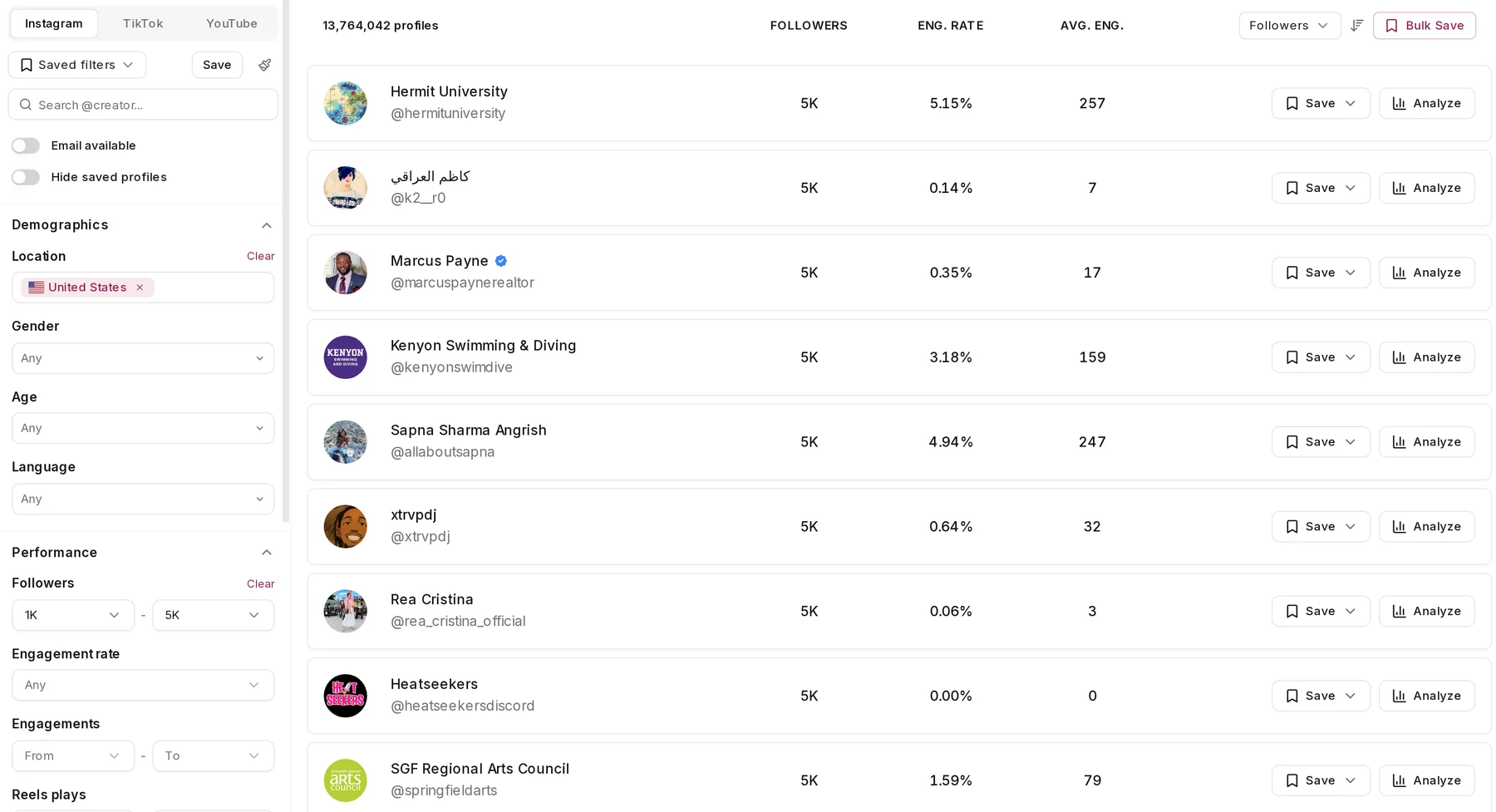
This is the failure mode of most micro influencer searches, and it is why people give up and go back to buying one big creator. Thirteen million rows is the same as zero rows.
Step 2: search the captions, not the bios
Under Content there is a Captions field. Type cream blush. Add an engagement rate floor of 3 percent while you are in there. That drops 13.7 million profiles to 3,788.
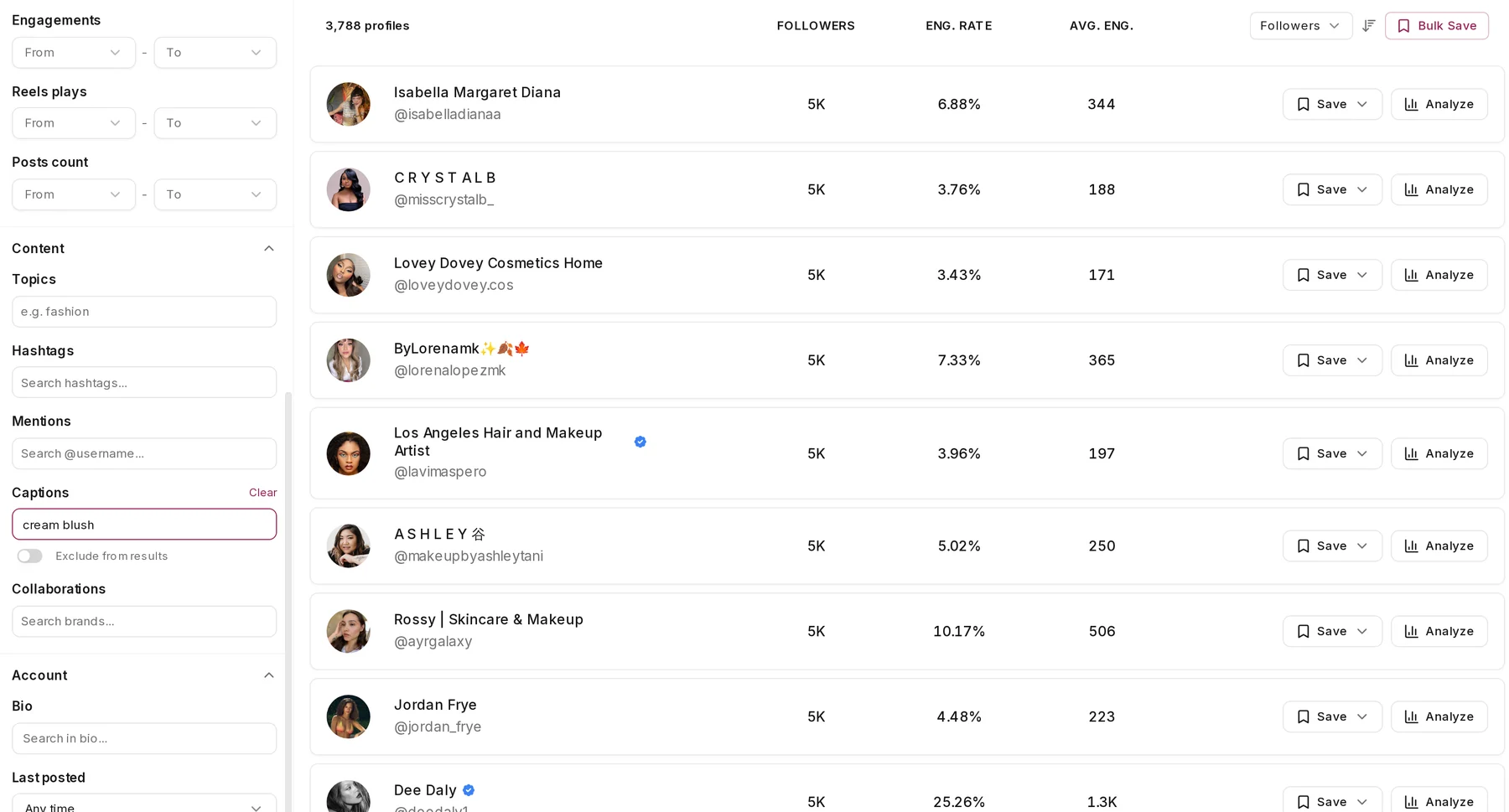
This is the inversion of Sturm's Google check. He picks a creator, then verifies. Starting from caption text means every single profile in the list is already a creator who writes about the thing you sell, in the words you sell it in. The verification step still happens, but on 20 profiles instead of 200.
Search the phrase the way a creator would type it, not the way your brand writes it. Nobody captions a Reel with cream-to-powder cheek product. They caption it cream blush.
Step 3: recency, and a way to reach them
Two more filters. Last posted, set to the last 30 days, cuts the list to 1,649. The Email available toggle at the top of the panel cuts it to 1,214.
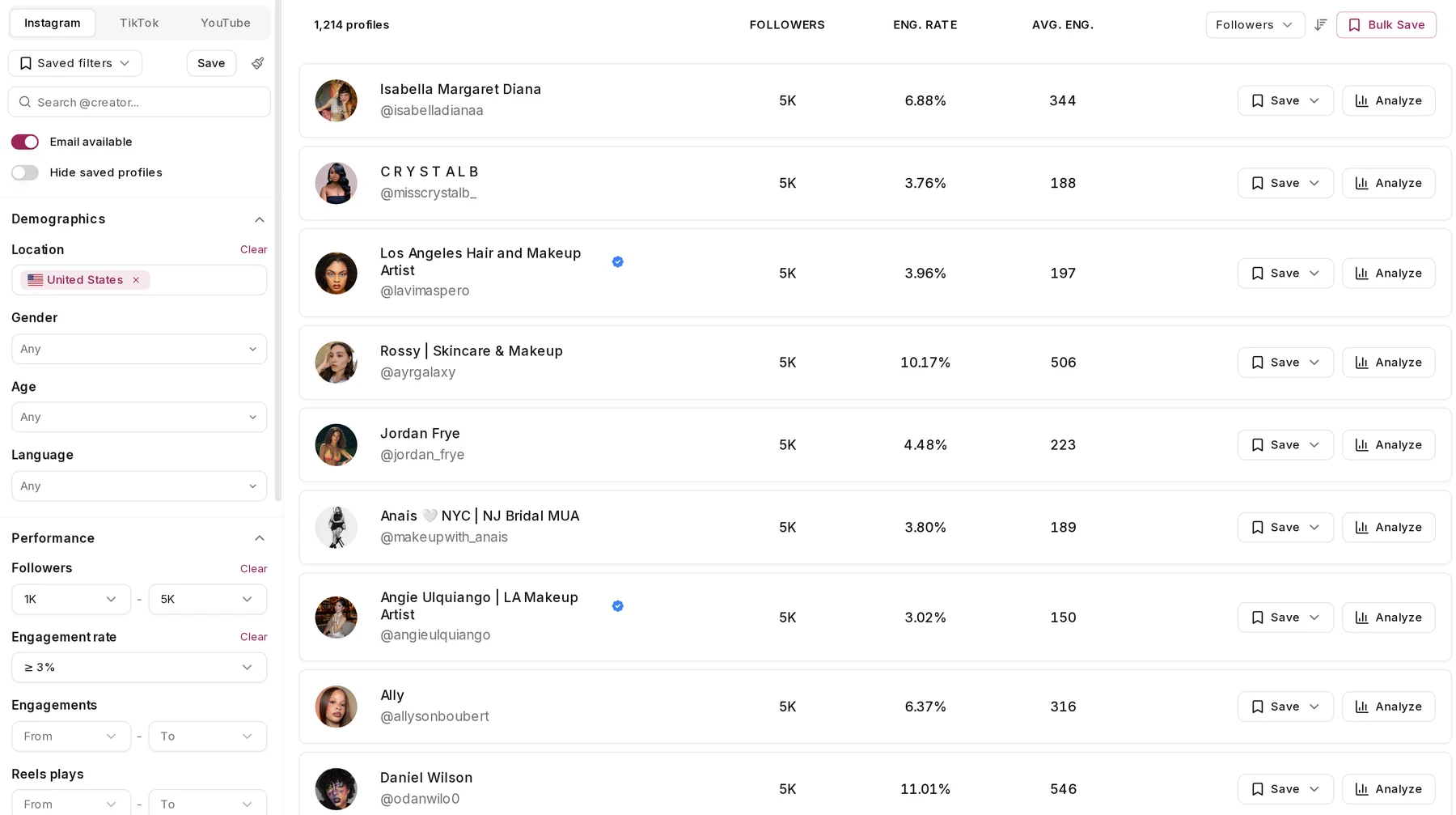
Recency is doing more work here than it looks. An account that has not posted in six weeks might be indexed, but it will not be reliable, and this play depends on the post going up in the window you planned it for. There is more on the individual filters in the discovery filters guide, and on the contact side in finding creator contact information.
Step 4: look at the audience before you send money
1,214 rows is still more than anyone will work through by hand. Analyze pulls the audience report on the ones you like. Here is one of the top rows, a 5K-follower creator in New York with 276 posts and a 6.88 percent engagement rate.
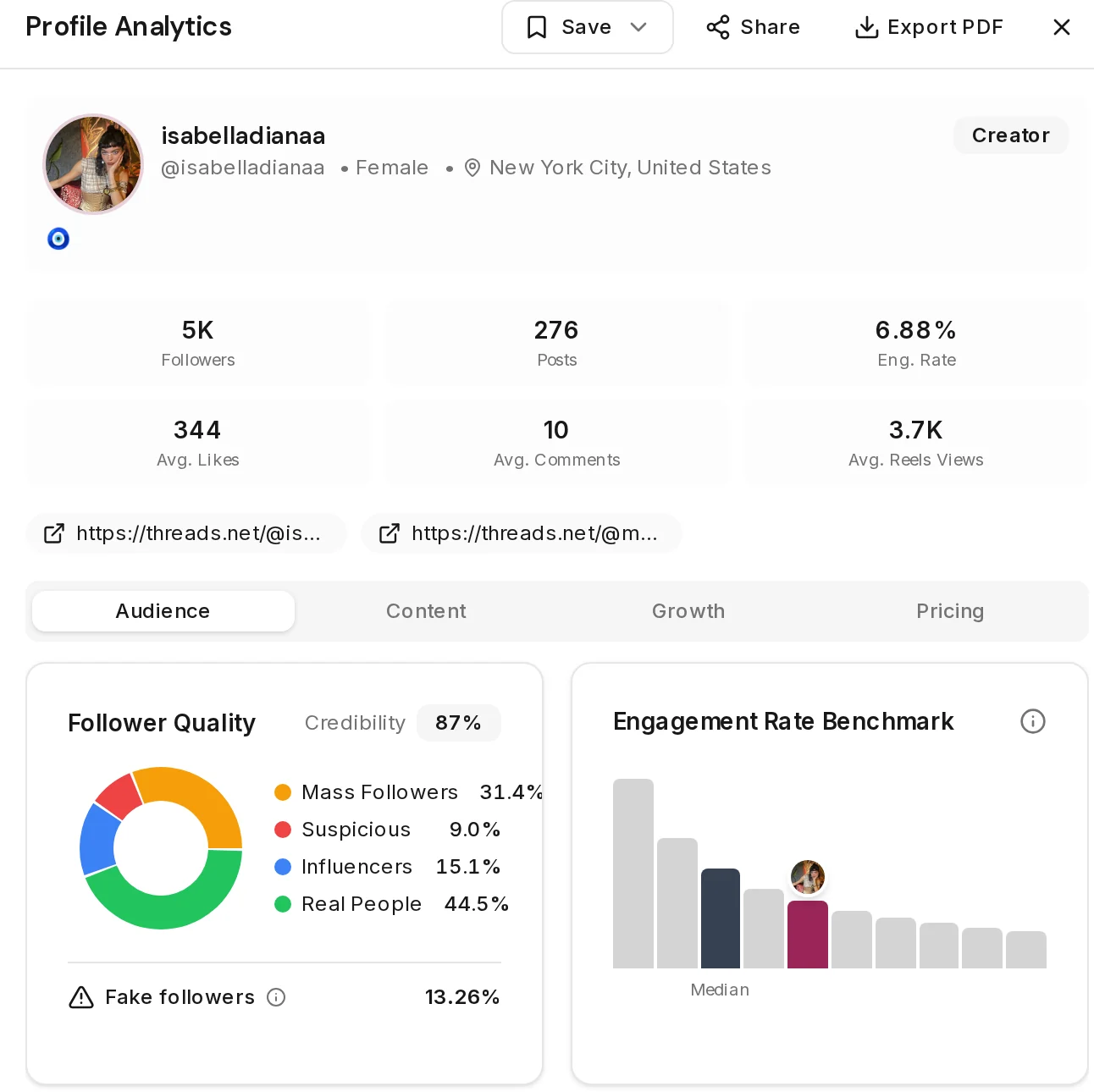
Thirteen percent fake is unremarkable at this size. Past about 25 percent I walk away, not because the creator is dishonest but because the engagement number stops meaning anything. Reading a profile analytics report covers what each block is telling you.
The Content tab is the one I would not skip for this particular play.
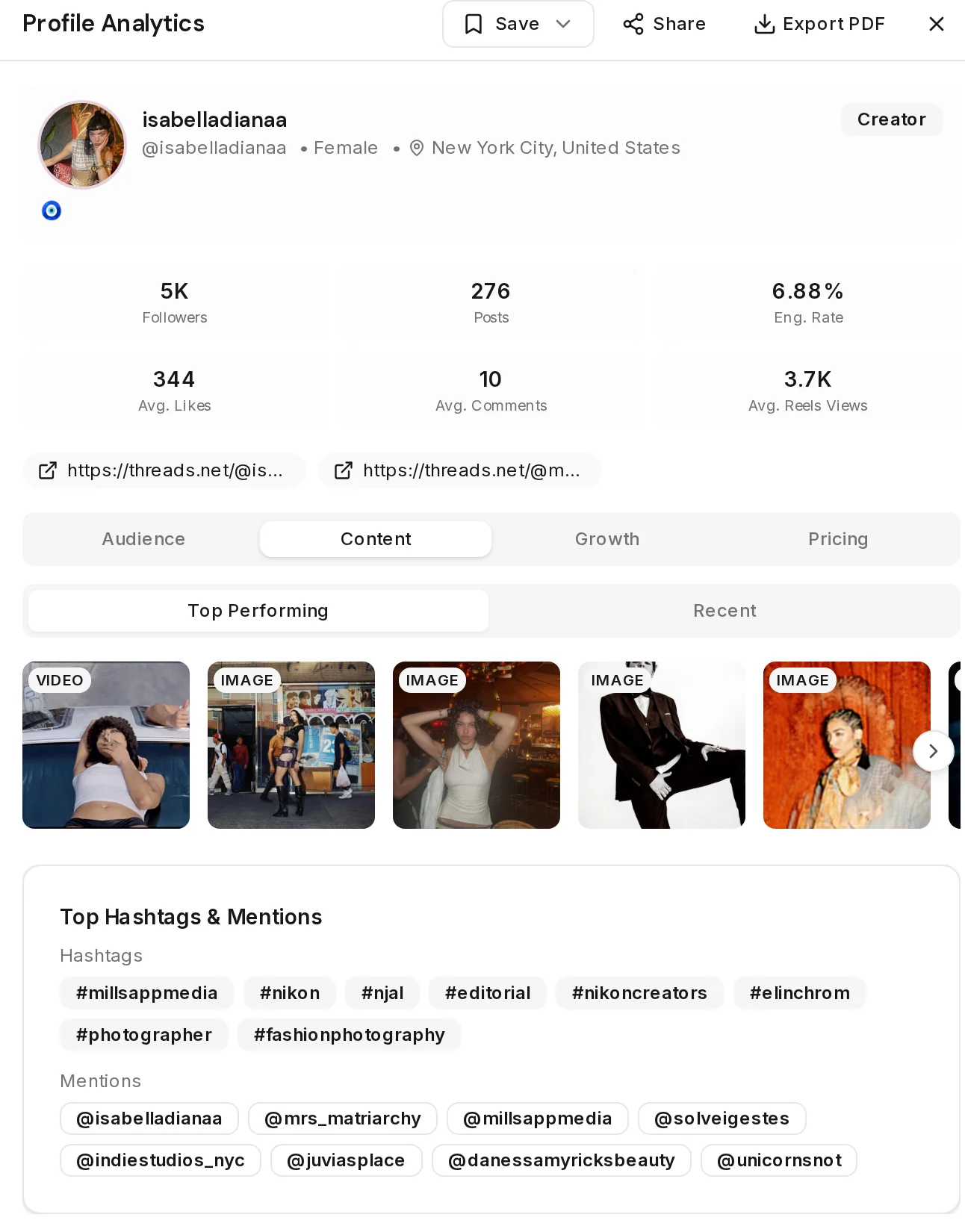
One detail worth noticing in that panel: the relationship sidebar showed a second profile for the same person, a TikTok account with 49.8k followers. You would be pricing the 5K Instagram account and getting the TikTok audience as well, provided you ask for both in the brief. That happens constantly in the nano band and almost nobody checks for it.
Step 5: run the same search on TikTok
Same filters, TikTok tab: 4,096 creators. The indexes are not the same size across platforms, which changes where you should spend the effort. TikTok holds 316,626,956 public profiles, Instagram 120,622,673, YouTube 15,741,021. That is more than 450 million profiles in total, and the bulk of it is small accounts.
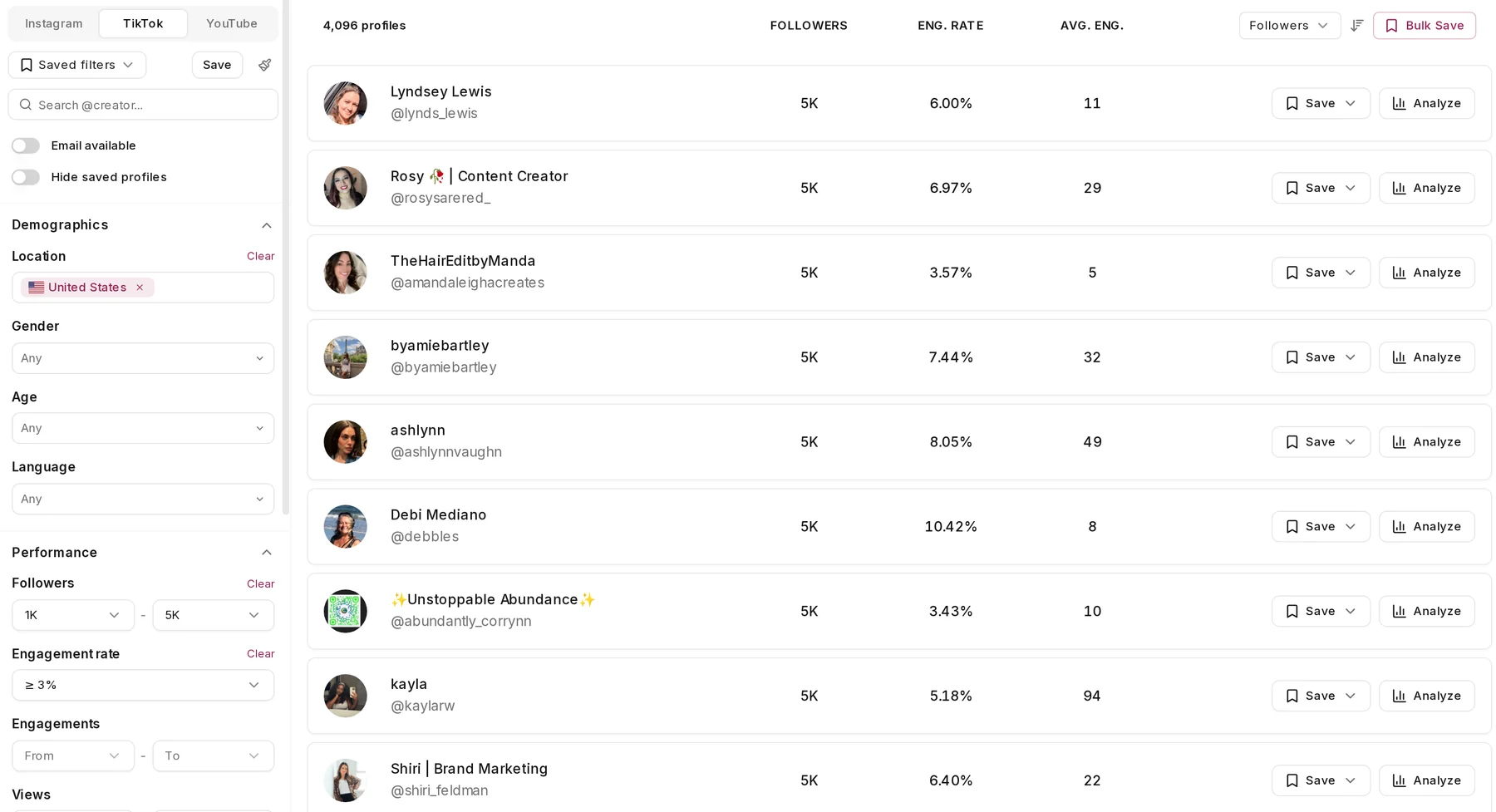
Filters do not carry across the platform tabs, so you rebuild them once per platform. Save the set and it becomes two clicks the next time. Saving and reusing a search walks through it, and it matters here because you will be doing this once per keyword, not once per campaign.
The brief you actually send
The pitch is short and it should be honest about the deal. Something like: we will pay you 40 dollars for one Reel about our cream blush, we will send the product, and we will send you the caption to use. Post it to Instagram and TikTok.
The caption is the deliverable. Instagram and TikTok both allow 2,200 characters, YouTube allows 5,000, and hardly anyone uses the room. Keyword in the first six words, then plain sentences about what the product does.
Vessa Cream Blush Stick is the cream blush for dry skin I keep
coming back to. It melts in instead of sitting on top, so it
does not cling to the flaky patches on my cheeks in winter.

What it is: a cream-to-skin blush stick in six shades,
fragrance free, made for dry and dehydrated skin.

Why I use it: no powder finish, blends with fingers, does not
break up over moisturizer or sunscreen.

vessa.com/cream-blush-for-dry-skin

#ad #creamblush #dryskinmakeup
The keyword sits at the front. The rest reads like a person, because a person is going to have to say it out loud. And the #ad is not negotiable: the FTC endorsement guides require disclosure on paid posts, and an undisclosed ad is a much bigger problem than any ranking it would win you.
Then mirror it on your own site. One page targeting cream blush for dry skin, with the phrase in the title, the URL slug, the H1 and the opening sentence. Four creators pointing at the same phrase, plus one page you control, is the whole structure.
Do not write the caption so tightly that four creators post identical text. Give each of them the same first sentence and let them write their own middle. Identical captions across accounts is the pattern the platforms already use to spot coordinated posting.
Track what actually posted
Here is the thing that quietly kills this play. You paid four creators, and now somebody on your team is opening four profiles every few days to check whether the post went up and how it did. By keyword three you are running twelve profiles. By month two nobody is checking at all.
Campaign monitoring handles that by watching hashtags and mentions instead of people. You add the creators, set the tracked tags, and it syncs on its own.
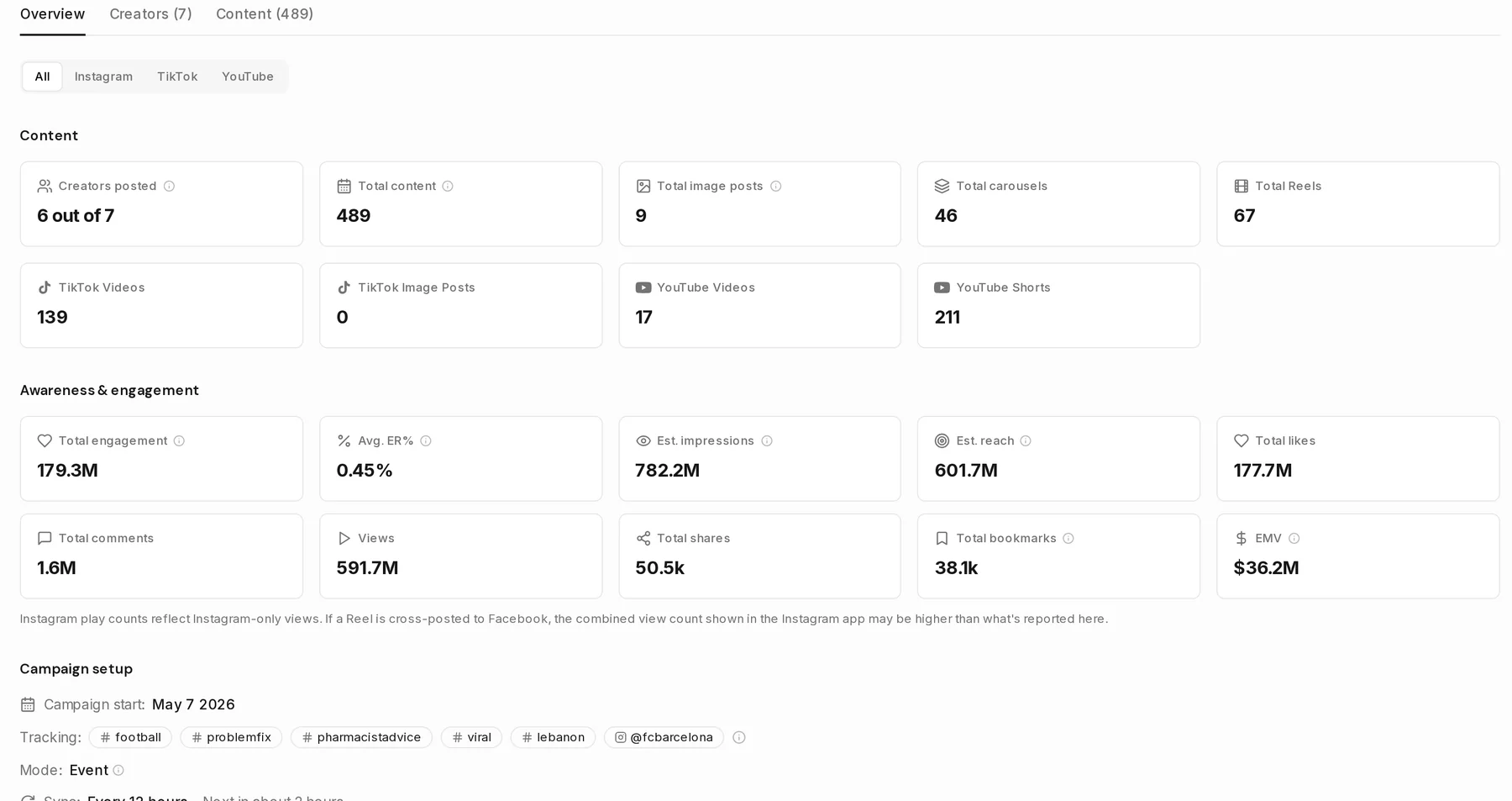
The creators view is where the argument for small accounts stops being theoretical.
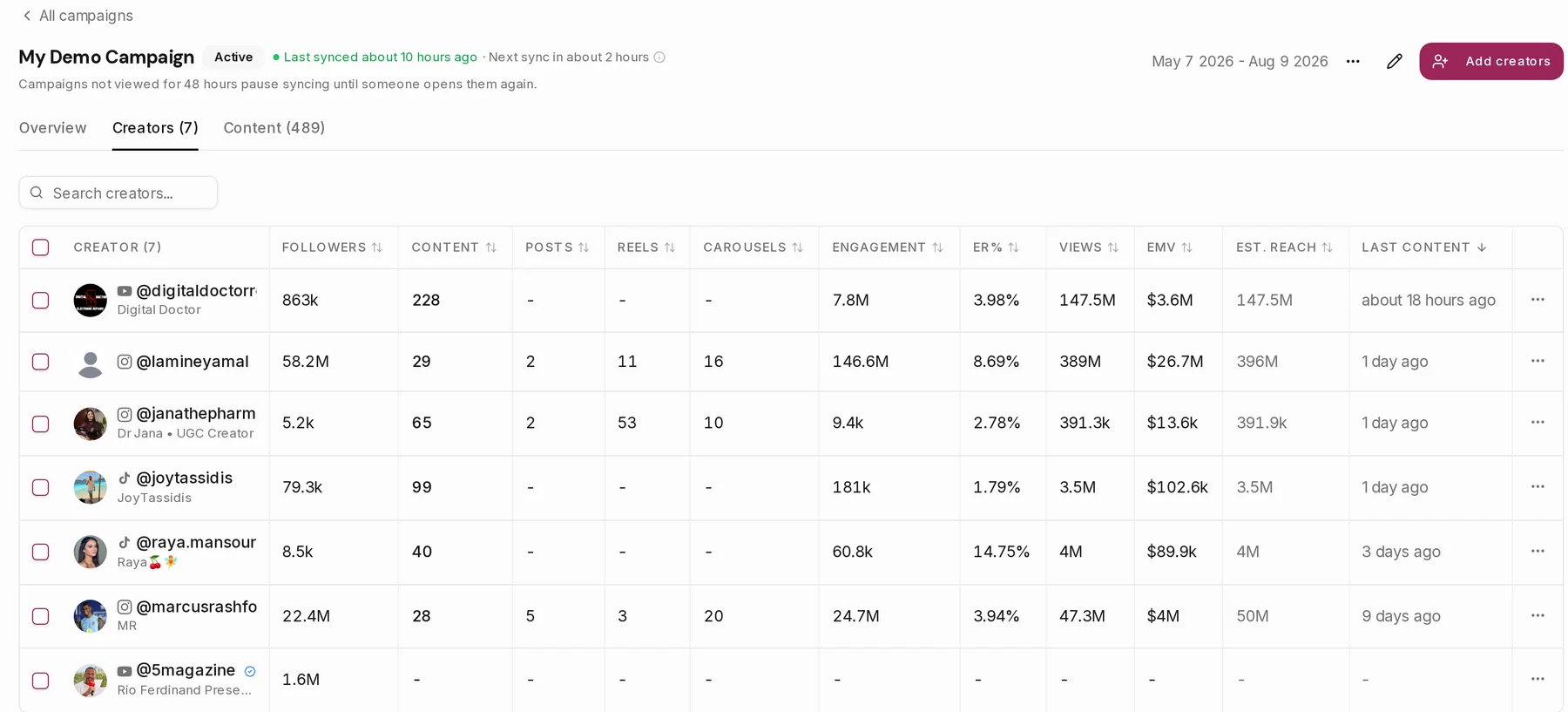
Look at the third row. A 5.2k-follower UGC creator produced 65 pieces of content and 391.3k views. Two rows down, an 8.5k-follower creator ran a 14.75 percent engagement rate, against 8.69 percent for the 58.2 million follower account above her. She cost a rounding error of what that account would cost. If you are optimizing for a text association that has to appear in several independent places, that is the row you want more of. Setting up a campaign and tracking its content cover the setup.
What this will not do
- It is not a link building play. Links in captions are nofollow and mostly unclickable. What you are buying is a repeated text association between your brand and a phrase, across accounts that are not yours.
- Indexation is not guaranteed. Verify it. Copy a recent caption into Google in quotes before you pay anyone, exactly as Sturm describes, and check how far back that creator's posts are indexed.
- Do not commission fake reviews of competitors. It apparently works today, which is precisely why the platforms will come for it, and it is a bad thing to be caught having paid for.
- One post proves nothing. Sturm's number is four creators on one keyword and ours is the same. Budget somewhere between 100 and 300 dollars per keyword, and give it a month before you judge it.
The number that keeps bugging me
What I keep turning over is how cheap the whole thing is relative to what it is competing with. Brands will happily spend four figures on one creator with a few hundred thousand followers, for a post that is gone from the feed inside 48 hours, and spend nothing at all making sure the caption on that post contains the phrase they want to be found for. Sturm's version costs 160 dollars and the text is still doing work next spring. The filters above are just the fastest way I know to find the four people who will write it.
Frequently asked questions
FAQ
Micro influencer SEO: common questions
The objections that come up whenever we walk somebody through this.
Find the creators whose captions already mention your product
Search 450M+ public profiles across Instagram, TikTok, and YouTube by caption text, engagement, recency, and contact details. 14 days free, no credit card.